
Kumar Sangakkara has been appointed to a Transformation Committee to oversee Sri Lanka Cricket (SLC), following the government's decision to remove the previous office bearers. The committee aims to overhaul governance and improve on-field performance.

Anura Kumara Dissanayake was sworn in as Sri Lanka's ninth president on Monday, amid hopes that he will bolster the country's economy and eliminate corruption.
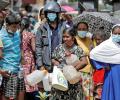
In what appears to be more trouble for President Gotabaya Rajapaksa and his elder brother Prime Minister Mahinda Rajapaksa's government, the main Opposition Samagi Jana Balawegaya party on Friday announced that it will move a no-confidence motion against the government if it fails to take steps to address the concerns of the public facing hardships due to the worst economic crisis in the island's history.
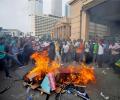
Angry protests in Colombo as Sri Lanka grapples with its worst ever economic crisis.

Sri Lanka's National People's Power of President Anura Kumara Dissanayake on Friday swept the parliamentary elections by winning a two-thirds majority, and also dominating the Jaffna electoral district -- the heartland of the nation's Tamil minority.

The 73-year-old United National Party was appointed as the prime minister by President Gotabaya Rajapaksa after they held closed-door discussions on Wednesday.
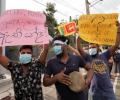
Ppolitical experts in Colombo said the ministers came under intense pressure from the public over the government's alleged "mishandling" of the economic crisis, triggered by the shortage in the foreign exchange reserve.

A delegation from former president Maithripala Sirisena's Sri Lanka Freedom Party met him in the morning to press for their demand on the formation of the interim government.

A top Sri Lankan official, who claimed before a parliamentary panel that Prime Minister Narendra Modi allegedly influenced President Gotabaya Rajapaksa to award a wind power project to the Adani Group in this island nation, resigned on Monday, a day after retracting his earlier statement.

Sri Lankan President Gotabaya Rajapaksa, who is under pressure to resign, was dealt a further blow on Wednesday when three more parliamentarians withdrew their support to the government.

Rajapaksa fled the country and resigned last month in the face of a popular uprising against his government for mismanaging the island nation's economy.

Anura Kumara Dissanayake, the leader of the Marxist Janatha Vimukthi Peramuna's (JVP) broader front National People's Power (NPP), on Sunday consolidated his lead in the Sri Lanka's presidential election.

Eyewitnesses said that a section of the protesters had remained for the all-night vigil.

Thousands of demonstrators have hit the streets since April 9, as the government ran out of money for vital imports; prices of essential commodities have skyrocketed and there are acute shortages in fuel, medicines and electricity supply.
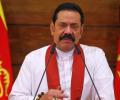
In a televised address to the nation, Mahinda, who is under growing pressure to quit due to the worst economic crisis facing the island nation, said that he understands the people's sufferings.

After nearly two days of political deadlock, the stakeholders are engaged in prolonged talks to try and appoint a successor to Mahinda Rajapaksa.
Mahinda Rajapaksa has been accused by the Opposition of inciting the ruling party mobs to attack peaceful protesters by making a defiant speech while addressing several thousands of his supporters to deflect calls for his resignation.

A statement issued by the presidential media division on Friday said an extremist group was behind the unrest near President Rajapaksa's residence in Mirihana.

Sri Lanka's embattled President Gotabaya Rajapaksa, under immense pressure from the public and the Opposition to quit over the island nation's worst economic crisis, said on Thursday that the abolition of the executive presidency, a move that will curb his powers, will be considered by Parliament.

Sri Lanka's main Opposition party Samagi Jana Balawegaya (SJB) on Tuesday handed over to the parliamentary Speaker motions of no-confidence against the Sri Lanka Podujana Peramuna (SLPP) coalition government and embattled President Gotabaya Rajapaksa, even as the government announced the appointment of a cabinet sub-committee to look into the proposal for a new Constitution.

Parliament met for a brief special session on Saturday to announce the vacancy in the presidency following the resignation of Rajapaksa.

Sajith Premadasa, the 55-year-old leader of Sri Lanka's principal opposition party Samagi Jana Balawegaya, said on Tuesday that he was withdrawing from the race of President to provide support to Alahapperuma.

Sri Lanka's main Opposition parties on Sunday agreed to form an all-party interim government after the anticipated resignation of President Gotabaya Rajapaksa on Wednesday, following unprecedented political turmoil that forced him and Prime Minister Ranil Wickremesinghe to offer their resignations over the mishandling of the nation's crippling economic crisis.

'The Indian government is better prepared this time and has reached out to all contenders and not putting all eggs in one basket.'

'There is fear that the president and prime minister are dragging their feet and won't resign.'

'India has given assistance that we required, otherwise we would not have been able to survive this far.'

The Government also defended the President's decision to enforce a state of emergency, that had given him sweeping authority to act in the interests of public security and preserving public order, including suspending any laws, authorising detentions and seizing property, saying it was declared after attempts were made to attack the President's Office and other public property.
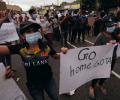
The government's poor handling of the economic crisis where people currently endure long hours of power outages and scarcity of essentials has angered the public which planned country-wide protests on Sunday.

Sri Lanka's Acting President Ranil Wickremesinghe on Monday imposed emergency giving him sweeping powers ahead of the key election on July 20 to pick a new President as he urged the political parties to put aside differences and form an all-party government, with the Opposition dubbing his decision as an 'undemocratic draconian act'.

The SJB has begun to collect signatures from MPs for the no-confidence motion, according to media reports.

The SLPP, led by prime minister Mahinda Rajapaksa, has won in 145 constituencies, bagging a total of 150 seats with its allies, a two-thirds majority in the 225-member Parliament, according to the results announced by the election commission.

Mahinda Rajapaksa, along with his wife and family, fled his official residence -- Temple Trees -- and took shelter at the naval base in Trincomalee.

Rulers in New Delhi and their political aides in sensitive states like Tamil Nadu have to be doubly careful not to provoke a situation whose consequences may be much more than visible now to the naked eye, notes N Sathiya Moorthy.

The protests brought home the fact that the Sri Lankan public is in no mood for halfway measures, as voices against Rajapaksa 'family rule' and 'securitisation' of the civilian administration began sidestepping the more critical economic crisis, affecting the nation and afflicting the individual, observes Sri Lanka watcher N Sathiya Moorthy.
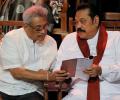
Gota has to decide if he could order elder brother Mahinda's arrest as the agent provocateur of Monday's violence. Then he has to prepare for an interim government, in which no one would now want to become a cabinet minister leave alone prime minister, explains N Sathiya Moorthy.
